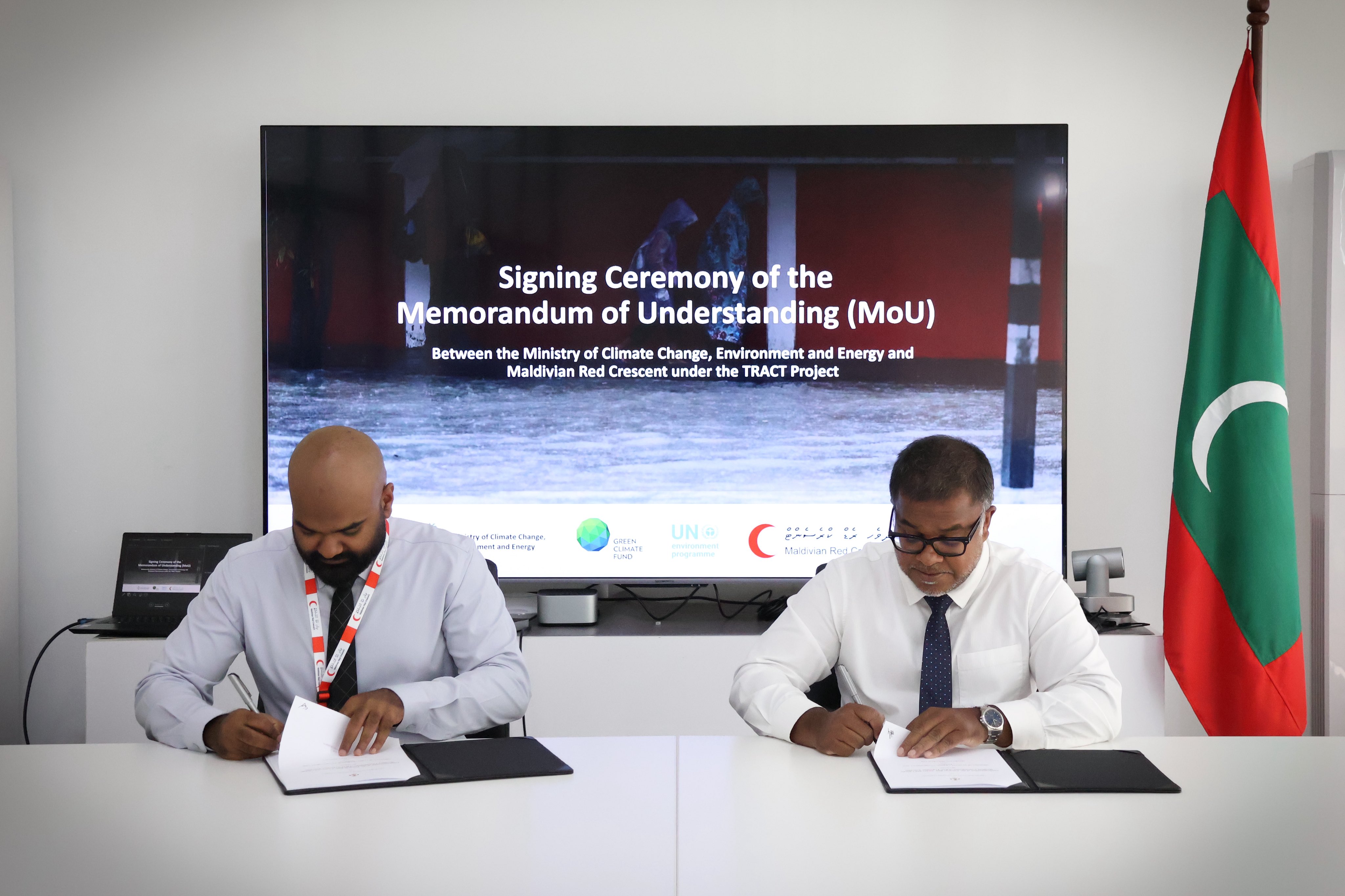
The agreement marks a significant step in the Maldives’ progress from responding to climate hazards towards anticipating them. TRACT brings together national efforts to strengthen observation and forecasting, streamline the communication of risk, and ensure that warnings reach communities and that people are prepared to act on them. It is the main vehicle for delivering the national Early Warning for All roadmap, which forms part of the global initiative to ensure that everyone is protected by early warning systems. Globally, the International Federation of Red Cross and Red Crescent Societies (IFRC) leads the fourth pillar of that initiative, Preparedness and Response Capabilities. In the Maldives, MRC serves as the national service provider leading this pillar, while also complementing work across the others.
MRC began engaging with UNEP and the Ministry on TRACT in 2023, building on its capacity and its role in disaster preparedness and response in the country in partnership with national actors. MRC’s contribution to the national Early Warning for All roadmap 2023-2027 informed the activities it proposed to the project, which were designed to address the gaps identified in the roadmap
At the centre of the project is community risk assessment and island disaster management planning through the national Community-Based Resilience Programme (CBRB), which MRC will implement across 48 islands over the five years of the project. Alongside this, MRC will establish Community Emergency Response Teams (CERTs), equipped and trained in First Aid and psychosocial support, in partnership and coordination with the National Disaster Management Authority (NDMA), so that community plans and response teams sit within the national disaster management system and support it. Delivered through MRC’s Regional Offices, Units and volunteers, this work puts community-led action at its core, with MRC volunteers mobilised across existing Units to equip island communities to prepare for and respond to hazards themselves.
Alongside this, as part of the project, MRC will work with all stakeholders towards streamlining early warning information and making it accessible to every community. The intention is to build climate literacy, public awareness and education that help communities understand the alerts issued by the Maldives Meteorological Service (MMS) and other actors, and the actions needed to prepare for them before a hazard arrives. Resources and knowledge products will be developed for use across different sectors, in schools, workplaces and community settings alike, contributing to existing national mechanisms and bringing a community lens to how early warning information is shared, understood and acted on. The project activities also includes a component on strengthening anticipatory action nationally, with MRC working alongside the Red Cross Red Crescent Climate Centre and other key national actors, as well as international and local service providers. This includes working towards the development of Early Action Protocols, which set out in advance the action to be taken when a forecast crosses an agreed threshold, and building the capacity needed to put them into practice, so that communities are supported before a hazard strikes, not only after it.
The agreement represents more than three years of work to bring all of these elements together, and MRC is proud to be one of the few non-governmental organisations contributing to a national initiative of this scale. The TRACT Project marks the beginning of a five-year effort to ensure that when an early warning is issued, every island community is prepared to act. MRC extends its sincere thanks to the Ministry of Climate Change, Environment and Energy, the United Nations Environment Programme, the Green Climate Fund, and its national and international partners for their trust and collaboration on such a landmark initiative.