Home
MRC Sri Lanka Relief Fund

MRC Sri Lanka Relief Fund

01st December 2025
MRC opens Sri Lanka Relief Fund to support people affected by Cyclone Ditwah

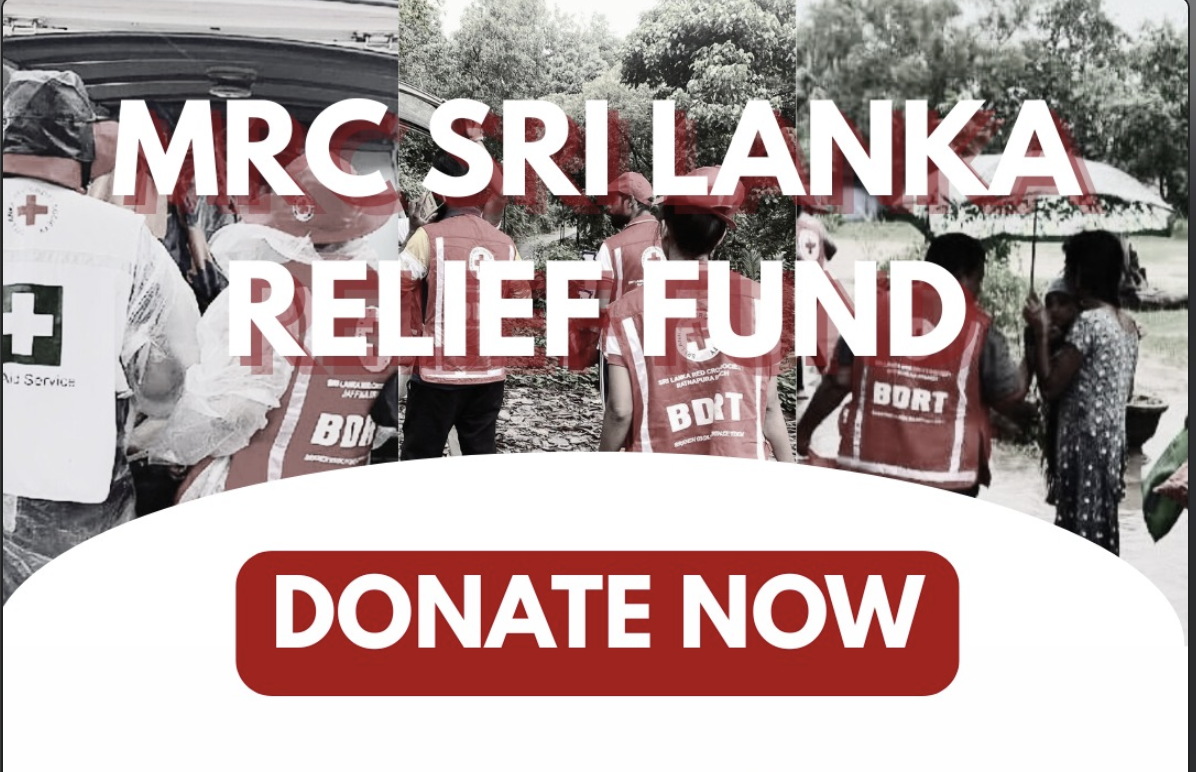
The Maldivian Red Crescent (MRC) has launched the “MRC Sri Lanka Relief Fund” to provide immediate relief and support the response and recovery efforts following the severe humanitarian crisis caused by Cyclone Ditwah. The fund will be open for 8 days, from 1 December 2025 until 8 December 2025.


MRC is encouraging USD contributions to help overcome temporary limitations affecting international fund transfers and to fast-track the first tranche of assistance. MRC will also work with local banks and businesses to support foreign exchange requirements for MVR donations. All funds received under this Emergency Appeal—aside from unavoidable bank transfer costs—will be entirely remitted to the Sri Lanka Red Cross Society (SLRCS) to ensure timely and effective assistance reaches affected communities.

About the MRC Sri Lanka Relief Fund

MRC’s Sri Lanka Relief Fund supports critical and timely assistance in response to the large-scale flooding and destruction caused by Cyclone Ditwah. Funds will contribute to:

  • First Aid services and medical support
  • Emergency relief distributions including drinking water, staple foods, hygiene products, clothing, and other basic essentials
  • Strengthening WASH (Water, Sanitation & Hygiene) interventions
  • Search and rescue capacity, supporting operations that remain stretched with more than 228 individuals still missing
  • Rapid community needs assessments carried out by SLRCS branches


These interventions are vital as access to affected districts continues to be hindered by damaged roads, inundated bridges, disrupted communication networks, and delays in dispatching relief supplies.


08th December 2025
MRC extends call for donations towards "MRC Sri Lanka Relief Fund" 

In light of the catastrophic flooding and landslides caused by Cyclone Ditwah and the urgent humanitarian needs outlined in the IFRC Emergency Appeal of CHF 5 million, the Maldivian Red Crescent (MRC) announces the extension of the MRC Sri Lanka Relief Fund.

The initial donation period was scheduled to close on 8th December 2025. However, the scale of devastation, the critical need for sustained assistance and due to the public appeal towards the extension of the fund, we are extending the period for donations till 10th January 2026. As of 2pm, 8th December 2025, the fund has raised MVR 186,201.94 and USD 4,671 reflecting the continued generous support of the Maldivian community.

Following the closure of the fund, these contributions will be entirely remitted to the Sri Lanka Red Cross Society (SLRCS) via the IFRC Emergency Appeal to support the delivery of humanitarian assistance, such as critical Health Services, essential supplies for the operation of humanitarian facilities, transfer of the sick and wounded, search and rescue,  provision of clean water, sanitation and hygiene, shelter and provision of basic relief items (including food, clothing, and household essentials).

Given the vital role played by the Sri Lankan Red Cross Society, MRC appeals to the Maldivian community to continue their support towards MRC’s Sri Lanka Relief Fund and to support the dedicated efforts of Sri Lankan Red Cross Society who are working tirelessly on the front lines


The bank account details are as follows: - 


Bank of Maldives

Maldives Islamic Bank

Account Name: Maldivian Red Crescent

Account Name: Maldivian Red Crescent

Account Number: 7730000379010 [MVR]

Account Number: 99010155500036100 [MVR]

Account Number: 7701176022002 (USD)

Account Number: 99010155500036200 (USD)


Situation Update Sri Lankan Red Cross Society (as of 4th December 2025)

Cyclone Ditwah struck Sri Lanka on 27 November 2025, with torrential rainfall exceeding 350 mm in 24 hours and triggering widespread flooding and landslides across all 25 districts. The disaster has affected over 1.46 million people, making it one of the worst crises in Sri Lanka in decades. Authorities report hundreds of deaths, with many people still missing as search and rescue operations continue. More than 230,000 people remain displaced, sheltering in overcrowded safety centers with limited access to water, sanitation, and hygiene. Over 20,800 homes have been damaged or destroyed, while severe infrastructure damage 78 roads and 15 bridges impacted, nearly 278,000 buildings inundated, and more than 65,000 power and telecommunications outages continues to restrict access to affected communities. Flooding remains a serious risk in downstream areas, with river levels in key basins still rising despite reduced rainfall.

Summary of Response from SLRCS and about IFRC Emergency Appeal

The IFRC has provided vital technical and financial support to the Sri Lanka Red Cross Society (SLRCS), enabling the pre-positioning of essential stocks such as shelter materials, hygiene kits, and health supplies in high-risk areas. This support also strengthened preparedness for disasters through Early Action Protocols and climate adaptation.

To enable immediate action, IFRC has already released CHF 100,000 from its Disaster Response Emergency Fund (DREF), with a further CHF 1 million allocation underway to scale up operations ahead of the full appeal. The IFRC Emergency Appeal will support emergency shelter, health, water and sanitation, livelihoods, and protection services, while strengthening community resilience to future climate-related shocks.

The Sri Lanka Red Cross Society has mobilized more than 3,500 volunteers, who are conducting rapid assessments, supporting evacuations, providing first aid, and distributing safe water, hygiene kits, bedding, and food rations.

“Our volunteers are working tirelessly to support communities who have lost everything,” said Dr. Mahesh Gunasekara, Secretary General of the Sri Lanka Red Cross Society. “Urgent needs include cooked food, safe water, medicines, and shelter, but the scale of devastation means sustained support is essential to prevent worsening food insecurity, disease, and poverty.”


Essential services have been severely disrupted. Hospitals and health facilities remain flooded or damaged, limiting access to care and disrupting maternal, child, and reproductive health services. Overcrowded evacuation centers are struggling to meet the needs of pregnant and lactating women, older persons, and people with disabilities, while mental-health and psychosocial needs are increasing. Access to safe drinking water remains critically compromised due to damaged and contaminated water systems.

- - - - - - - - - - - -- - - - - - - - - - - - - - - - - - - -- - - - - - - - - - - - - - - - - - - -- - - - - - - - - - - - - - - - - - - -- - - - - - - - - - - - - - - - - - - -- - - - - - - - - - - - - - - - - - - -- - - - - - - - - - - - - - - - - - - -- - - - - - - - - - - - - - - - - - - -- - - - - - - - - - - - - - - - - - - -- - - - - - - -

Summary of the Situation in Sri Lanka (as of 30th November 2025)

Sri Lankan Red Cross Society (SLRCS) Response Efforts 

Cyclone Ditwah continues its northwestward track, leaving widespread devastation across Sri Lanka, particularly in historically vulnerable regions. Torrential rainfall exceeding 200 mm in 24 hours, and over 540 mm in some districts, triggered catastrophic flash flooding along major river basins. As of 30 November 2025, authorities report 41 homes fully destroyed and 666 partially damaged, with figures expected to increase as assessment teams access remote areas.


The Government of Sri Lanka has declared a state of emergency as all districts have been severely affected. Although the cyclone system has shifted toward the northern coasts of India, critical conditions persist, and flood risks remain elevated.

The Sri Lanka Red Cross Society (SLRCS), working alongside government and emergency agencies, has mobilized teams to support the 12 million people across 9 provinces affected by the cyclone. More than 3,500 volunteers are currently:

  • Supporting evacuations
  • Conducting search and rescue operations
  • Providing First Aid and urgent assistance
  • Distributing drinking water, hygiene items, basic household necessities
  • Leading initial assessments to guide targeted response operations


Major operational constraints include:

  • Restricted access due to road closures, landslides, and damaged bridges
  • Limited search and rescue capacity to locate over 228 missing people (as of 30th November 2025)
  • Communication disruptions caused by power outages
  • Overwhelmed health services in several districts


Immediate needs include mobile medical teams, essential medicines, mental health and psychosocial support, and enhanced disease surveillance to prevent outbreaks such as dengue and waterborne illnesses.

IFRC DREF Mobilization & Ongoing Coordination

The International Federation of Red Cross and Red Crescent Societies (IFRC) has activated its Disaster Response Emergency Fund (DREF) to support SLRCS in delivering immediate relief. At the same time, SLRCS and Movement partners are developing a comprehensive response and recovery plan for the next phase of operations.